Sharing my self-review feels quite vulnerable. It means being open about what I’m proud of, but also the deadlines I missed, the things I haven’t given enough attention to, and the areas where I still need to grow.
But I think that’s useful. Writing a performance review isn’t just about collecting your best work and giving yourself a pat on the back. It’s an opportunity to understand your contribution, acknowledge the choices you made, and get clearer about what comes next.
At ConvertKit, our review process involves answering a series of questions about the past six months and the next six. Your manager answers the same questions, and then you compare your perspectives to see where you’re aligned. I hadn’t had that conversation with my manager yet when I wrote these answers, so this is my own assessment, not the final verdict.
Here’s how I approached each part, including why I chose particular examples. And if you’re here partly because you’re nosy, that’s okay too.
Key Takeaways
- Explain missed commitments honestly, including the tradeoffs and changes you need to make.
- Choose impact examples that demonstrate your scope and show action on previous feedback.
- Use role expectations to assess strengths and select focused development areas.
- Advocate for your contribution while acknowledging where you still need to grow.
Table of Contents
- 1. Be Honest About Delivery, Even When the Context Is Complicated
- 2. Choose Impact Examples That Show the Scope of Your Role
- 3. Include the Ways You Helped Other People Succeed
- 4. Name the Challenges Alongside the Wins
- 5. Give Your Strengths Proper Attention
- 6. Rate Your Overall Performance Against Reality
- 7. Separate Ongoing Growth From an Immediate Promotion Goal
- 8. Pick Focused Development Areas, Not Every Possible Improvement
- 9. Choose Three Initiatives Where You Want to Make an Impact
- Use Your Self-Review to Advocate for Yourself Without Avoiding Critique
1. Be Honest About Delivery, Even When the Context Is Complicated
The first question asks how well I delivered on projects and deadlines over the previous six months. There are four rating options, ranging from setting a new standard to needing improvement.
My answer? My delivery needs improvement. Starting strong with the uncomfortable stuff.
As Creative Director, I’m in a player-coach role. Part of my job is managing, supporting, and enabling my team. But I also have individual contributor responsibilities, meaning projects where I need to do the work myself.
I missed several deadlines on that individual contributor work because I prioritized helping my team succeed. I actually think that was the right priority. But it doesn’t remove the need to address those missed deadlines.
I need to either find a way to do both parts of the role well or take on less individual contributor work. I also tend to be overly optimistic about timelines, which contributes to the problem.
That distinction matters in a self-review: you can explain the context without using it to avoid responsibility. I can stand by the decision to support my team and still acknowledge that my commitments needed to be more realistic.
2. Choose Impact Examples That Show the Scope of Your Role
Next, I needed to highlight three areas where I’d made an impact. I chose these deliberately:
- Bringing on Superside as an external partner. I researched the options, made the decision, and helped onboard and ramp up the partnership so we could use that resource effectively.
- Developing a motion graphics production process. I worked on and iterated our approach so we could produce motion graphics more regularly.
- Helping define our culture of execution. I collaborated with Nathan, our CEO, on a management project to clarify what execution should look like at ConvertKit.
I wanted these examples to show more than a list of completed tasks. They demonstrate strategic thinking, identifying resource constraints, and finding ways to improve how we work. They also show impact beyond my immediate team.
The motion graphics example served another purpose: it connected directly to feedback from my previous review. My manager had wanted us to produce more of that work, so this was an opportunity to show that I’d listened and acted on it.
Being selective isn’t about putting a spin on your performance. It’s about choosing evidence that helps your manager understand the level you’re operating at and the progress you’ve made.
3. Include the Ways You Helped Other People Succeed
There’s a separate question about how I enabled my team to achieve success. I won’t share the individual examples because those involve other people’s work and development, but my answers focused on three areas:
- Prioritization: Helping people connect their work to what the business actually needed from it.
- Delegation: Thinking carefully about where I should spend my energy and where someone else should take ownership.
- Coaching: Providing mentorship and support that helped a team member earn a promotion.
For a manager, your impact isn’t limited to what you personally produce. Helping someone find clarity, take on responsibility, or progress in their career is part of the work too.
4. Name the Challenges Alongside the Wins
This is where things get a little spicy. The next question asks about challenges and wins from the past six months, and I wanted to be honest about both.
Challenge: Writing Resources Had Become a Blocker
We’d made progress on our design resource constraints, although there was still far more work than we could possibly complete. But I’d noticed another gap: writing.
Without someone focused on the writing, projects were either moving more slowly or not reaching the standard I knew they could. It had stopped being a nice-to-have resource and had become a blocker.
So I included an action item: work on bringing in a contractor to help in that area. Naming the constraint is important, but so is identifying what I can do about it.
Challenge: I Was Still Recovering From Burnout
I’d brought up burnout in my previous review, and I wanted to revisit it rather than assume that feeling better meant I was fully recovered.
The previous six months had felt better than almost all of the year before. That was progress. But I still didn’t feel recovered, and I wanted my manager to know that it remained a challenge.
I think a performance review is a valid place to discuss this sort of thing. It’s part of the reality of how work is going, not something I need to pretend is irrelevant.
Win: Establishing a Baseline for Brand Awareness
One win was prioritizing a brand awareness survey and making it happen in a small, scrappy way.
It gave us something useful to learn from: a baseline for how people perceived our brand. As the manager of the Brand Studio team, part of my role is understanding how to measure the success of our work. That’s a very difficult thing to do, but I wanted to show that I was actively working on it.
Win: Making Team Capacity Visible
Another win was introducing a capacity view in monday.com, which we use for project planning.
We estimate roughly how many days a piece of work will take, then compare the planned workload with the working days available in the month. That helps us identify:
- Who has more work planned than they have capacity for.
- Who might have room to take on another project.
- Whether there’s space to act on a new idea.
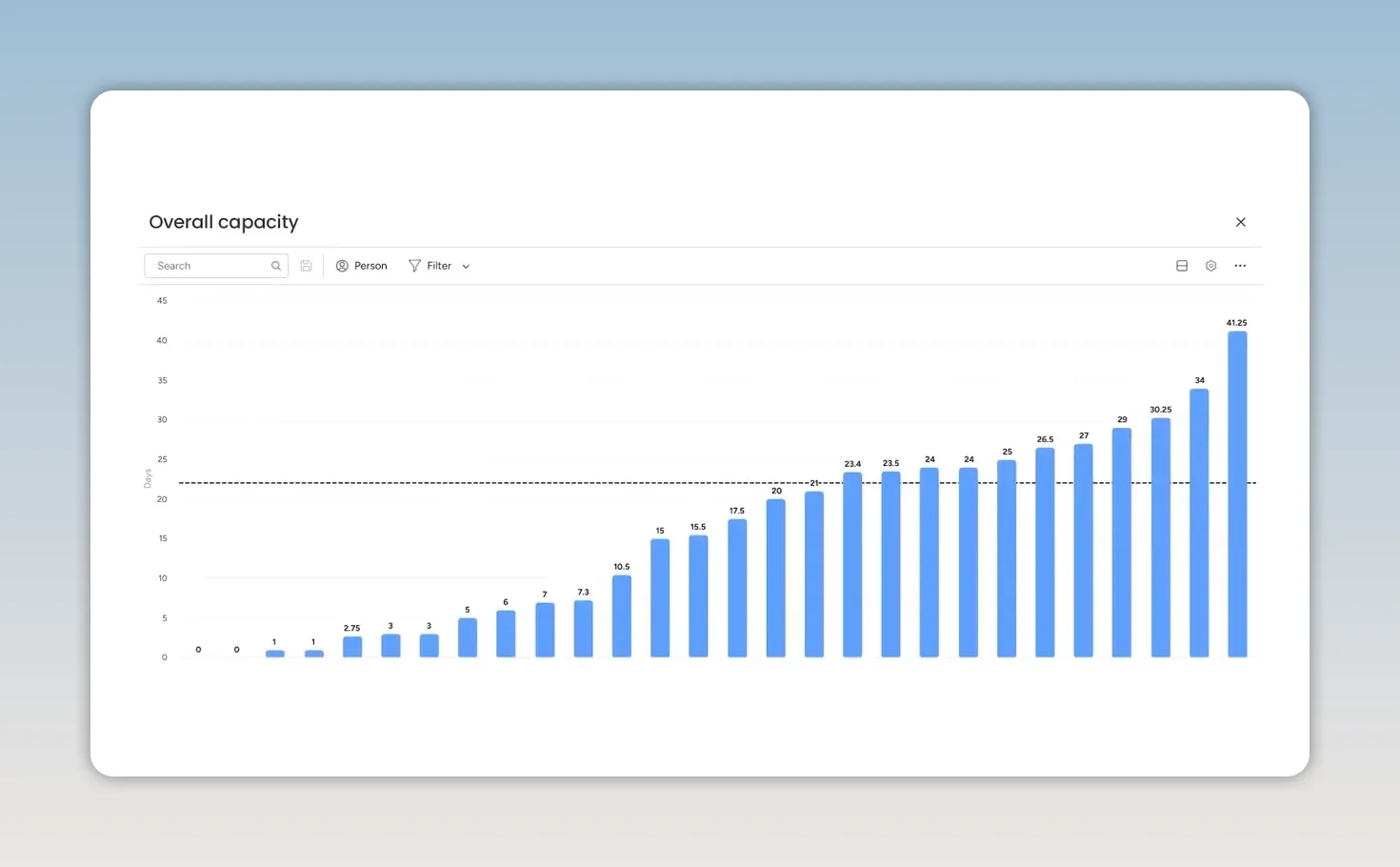
I initially introduced this because I knew my team needed it. Then I shared it with the rest of the growth leadership team, and it became part of our monthly planning process.
That made it a useful self-review example: something that began as a team-level improvement ended up helping the wider organization.
5. Give Your Strengths Proper Attention
The next question asks for one or two things I excelled at and should continue doing. Our answers need to connect to our role matrix, company values, or culture of execution.
I really like having those reference points. A role matrix sets out the behaviors and competencies expected at your level, so you’re not trying to assess yourself against a completely vague idea of “doing well.”
I chose two strengths.
Initiating and Facilitating Complex Conversations
I feel I’ve been an important contributor in growth leadership meetings by bringing up difficult issues and helping us talk through them together.
Speaking up about those things has helped improve our planning and our alignment around campaigns. That’s worth recognizing, even though it doesn’t look like a finished design asset I can point to.
Prioritizing the Right Work
I also felt good about how I’d kept the team focused. We’d struck a balance between meeting other teams’ needs, including creating the assets they rely on, and making time for work we knew would improve our brand.
There’s a reminder here for me as much as for anyone else: pay attention to positive feedback, not just criticism.
It’s easy to hear one thing you need to improve and make that the entire story of your review. But your manager likely wants you to keep doing the things you already excel at while you work on those growth areas. Knowing which efforts are being recognized helps you preserve those strengths.
6. Rate Your Overall Performance Against Reality
For my overall performance rating, I said that I consistently met expectations.
As an overachiever, I did not particularly enjoy choosing that answer. Of course I would rather put myself in one of the higher categories. But given the missed deadlines on my individual contributor work, I felt it was the honest assessment.
The company was also entering a new phase, with higher expectations for our product, operations, and how we worked together. I knew I still had work to do to make those expectations clear for my team and define what it would mean for Brand Studio to truly excel.
I felt motivated by that. I wanted to get to the next review in six months and have evidence that I’d exceeded expectations.
But wanting a higher rating next time isn’t a reason to give myself one now.
7. Separate Ongoing Growth From an Immediate Promotion Goal
Was I working toward a promotion? My answer was no, not immediately.
I’d been promoted the previous year to level four in our manager matrix. Within our structure, moving from level four to level five is a significant jump that requires substantial growth.
That didn’t mean I wanted to stand still. I was already using the competencies and behaviors for level five to guide my development, with the intention of starting to work toward that promotion in 2024.
I like that our review includes this question because it creates space for two conversations:
- With your manager: Are you aligned on your promotion ambitions and what growth would be needed?
- With yourself: Do you actually want to work toward a promotion right now, or are you still growing into your current level?
You can be intentional about development without making an immediate promotion the goal.
8. Pick Focused Development Areas, Not Every Possible Improvement
For the next six months, I needed to identify one or two areas to improve or get coaching on, again using our performance expectations as a reference.
Having that framework is helpful. Rather than staring at a blank page and trying to think of everything I could do better, I can look at a defined set of competencies and choose where to focus.
I chose one strategic area and one more tactical area.
Long-Term Brand Strategy
I’d spent a lot of energy on team operations: helping us run smoothly, finding resources, and putting systems in place. What hadn’t received enough attention was the longer-term direction of our brand.
I had a clear understanding of where the company was going over the coming years. My next step was to work out how the brand needed to grow alongside it.
That meant thinking about what needed to change in people’s perception of us and in how we approached our work to support the company’s goals.
Improving the Marketing Site
My second focus was building a stronger rhythm of marketing website improvements:
- Getting access to useful data.
- Identifying opportunities for improvement.
- Developing hypotheses.
- Running tests.
We were starting to find a better cadence, and I wanted that to continue and increase. The design system work I’d started, but hadn’t made much progress on, would be part of this too.
These two areas gave me a balance between defining where we’re going and improving something concrete along the way.
9. Choose Three Initiatives Where You Want to Make an Impact
The final question asks for three initiatives at the team, organization, or company level that I want to influence over the next six months.
Obviously, there are more than three things I’d like to contribute to. But I appreciate the limit. It makes me choose what matters most.
A Campaign About Being Built by Creators, for Creators
One planned campaign focused on ConvertKit being made for creators by creators.
I saw that as an important differentiator in the email marketing software market. The company was started by a creator, and creators were at the heart of what we did. Our brand team could add value by making that positioning clearly known and deeply understood.
Better Product Marketing Systems
Our marketing team, particularly our product marketing manager, was doing great work to make campaign planning less chaotic.
The approach included campaign levels that clarified what each campaign needed. For example, a gold-level campaign would come with expectations about the number of assets and the type of landing page required.
I wanted to connect our brand design system to that structure so our team could work just as smoothly. It was also an opportunity to improve collaboration between brand and marketing.
Contributing to the 2024 Company Strategy
My manager had previously asked me to contribute more at the company level. I wanted to acknowledge that feedback by explicitly setting a goal to participate in our 2024 strategy planning.
Again, this was about making the connection visible: here’s the feedback I received, and here’s how I intend to act on it.
Use Your Self-Review to Advocate for Yourself Without Avoiding Critique
Looking back, I felt I’d had a good six months. I’d worked through chaos and helped make things calmer for the team by focusing on systems and design operations.
But that focus came at a cost. Some of my personal project deadlines slipped, and longer-term strategy didn’t receive enough attention.
I’m okay with recognizing that as a choice I made. I also think it deserves critique. Could I have reduced the scope of some projects? Could better systems, established earlier, have prevented some of the pressure? Those are useful questions, not reasons to dismiss everything that went well.
Across my answers, I tried to choose examples that either connected to previous feedback or demonstrated contribution at different levels: an individual team member, the team, the wider organization, and the company.
A performance review is a chance to show that you understand your role and can explain how you’re fulfilling it.
In our process, this review wasn’t a direct opportunity to negotiate a raise. Raises came through promotions or updates to standardized salary data. The immediate purpose was alignment with my manager. Even so, it was absolutely a time to advocate for myself.
That means highlighting strengths, being specific about impact, and acknowledging development areas without embarrassment. Having things to improve doesn’t invalidate the work you’ve done.
You can be proud of your contribution and honest about where you need to grow. That’s the kind of self-review I want to write.


