Some weeks, I add more to my to-do list than I check off. This was absolutely one of those weeks. It was also a productive one, which is a useful reminder that the length of a task list is not the whole story.
My work as Creative Director at Kit involves brand strategy, creative direction, people management, campaign decisions, and a fair amount of figuring out what needs my attention most urgently. There is hands-on design in there too, but it sits alongside all the work that helps other people make good creative decisions.
I work remotely from Spain for a US-based company, so my usual hours are around 11 a.m. to 7 or 7:30 p.m. That gives me some quieter time before most of my colleagues come online, with meetings generally happening later in the afternoon.
Here is what that looked like across a very real week: a brand awareness survey, some positioning breakthroughs, an unexpectedly involved design challenge, and a company update that took considerably longer than I thought it would.
Monday: Making a Plan, Starting With Strategy
I started Monday with coffee and a book rather than Slack. Both my manager and our CEO had recommended it, and it was directly relevant to a positioning project I am leading.
When leaders in your company keep referring to a particular book, theory, or piece of media, I think it is worth spending time with it yourself. Not just so you understand the reference, but so you can understand what they are finding valuable and bring that thinking into your own work.
Why we are revisiting Kit’s positioning
Kit makes email marketing software for creators. A couple of months earlier, we had launched Subscriber Signals, a feature that gives creators demographic information about the people on their email lists.
This kind of information had previously been more associated with enterprise solutions than tools for a creator running an online business. It changes the value we can offer, which means we need to evolve how we communicate that value.
My project involves repositioning Kit in the market, including changes to our messaging and elements of our brand expression. The reading was not separate from the project. It was part of doing the strategic work properly.
The book also included skills that could be installed in Claude Code to help work through its thinking. I installed those, realised the exercises looked fairly involved, and decided they deserved a proper block of time on Tuesday.
Planning around the time I actually have
We use Notion for project management, and I have a personal task dashboard for planning my days. At the start of the week, I review unfinished tasks, move the relevant items from next week into this week, and work out what belongs on today’s list.
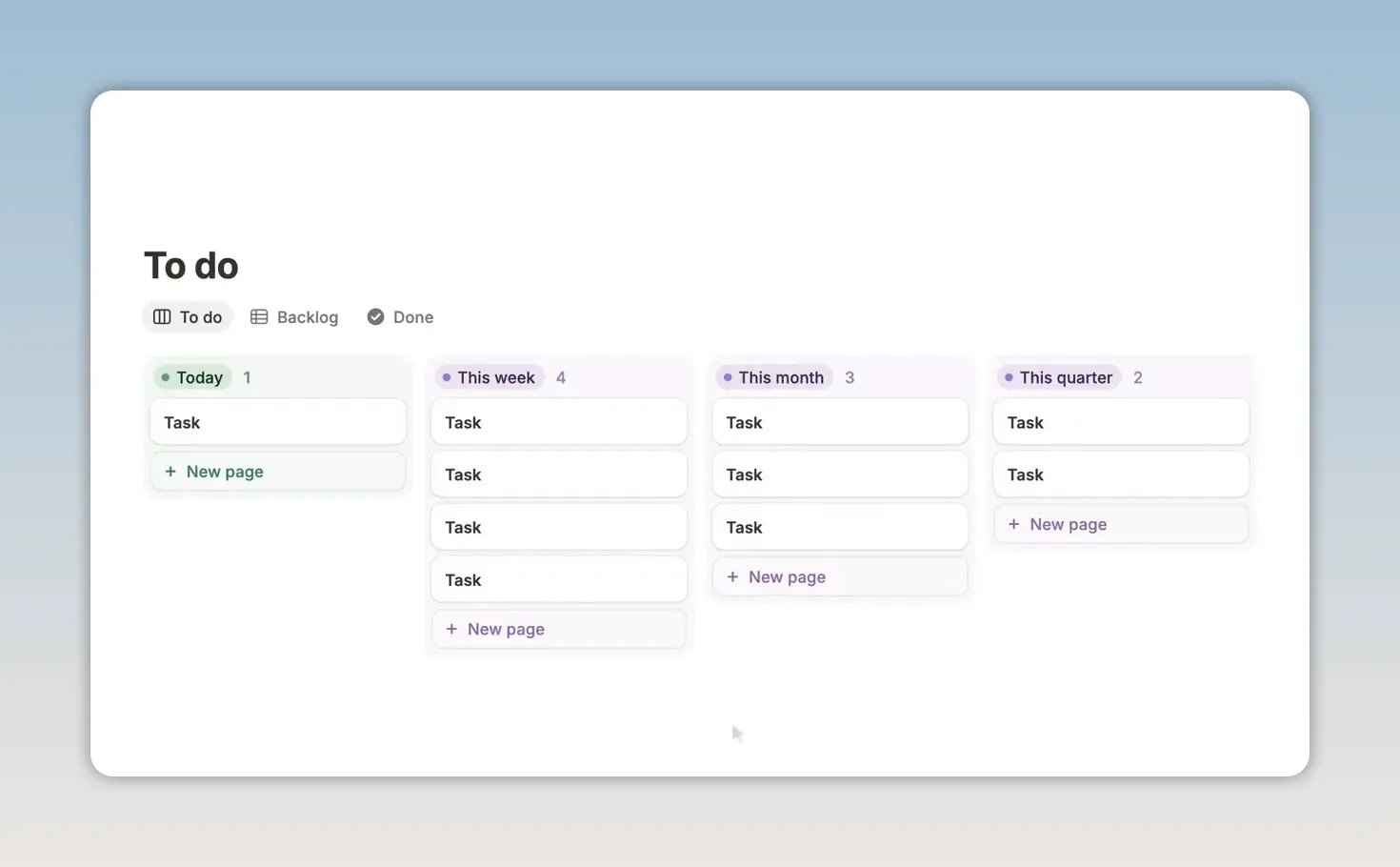
I look at my calendar before deciding how much work to assign myself. A day with several meetings is not the same as a day with a clear afternoon, even if both start with an equally ambitious list.
Monday included meetings with our agency and internal team about the general availability launch campaign for Subscriber Signals, plus a sprint kickoff that I was leading.
We had been working in two-week sprints for roughly six months. They were helping us find focus, but the logistics still required quite a bit of organisation from me. I had recently hired someone part-time to help with project management and systems, so preparing for her arrival was another task for the week.
I also keep a separate monitor list. These are projects where I do not currently have an action to take, but I need to remember to check back. Perhaps I am waiting for feedback, or waiting for results before deciding what happens next. Keeping them separate means they do not disappear just because they are not actionable today.
The main goal for Monday was to get a brand awareness survey started, alongside campaign work and communications. First, though, I needed to check Slack for anything that had happened after I signed off on Friday.
A small list for my own business
Alongside my Kit dashboard, I keep a little paper card on my desk with a few things I want to do for my own business. I am getting back into running it and making content again, and it is very easy for that work to slip if I do not deliberately prioritise it.
This week’s list included editing two more chapters of my book, working on the newsletter landing page for my personal website, and carrying over an unfinished task from the previous week. Nothing elaborate. Just a visible reminder of what I had told myself mattered.
Tuesday: Brand Research and an Ideal Customer Breakthrough
Tuesday started at 11:45 a.m. because Monday had run late. Getting the survey ready involved more refinement than expected, and I wanted the details right before it went out.
We had done brand perception surveys before, usually by sharing a Typeform with our own audience. Those had been useful, but there is a limitation: the people who volunteer to respond are often your most engaged audience members.
For brand awareness, surveying existing customers is also not particularly revealing. We already know they have heard of us.
What we wanted the brand awareness survey to tell us
There were two core awareness questions:
- Unaided awareness: Which email marketing platform brands come to mind without looking anything up?
- Aided awareness: Which brands do people recognise when shown a list containing Kit and competitors?
Those questions measure different things. One asks whether we come to mind when someone thinks about the category. The other asks whether our name is familiar once it is presented.
Because ConvertKit rebranded to Kit in 2024, we included both names in the list. I was particularly interested in whether people would recognise ConvertKit but not Kit. We also asked directly whether they had known about the name change before taking the survey.
There were brand perception questions too, looking at the associations people have with different tools. Finding the right people to answer was one of the hardest parts of the research.
And then, while thinking through it all, I realised a question appeared to have been missed. After all that checking the night before. Very frustrating.
I left a note to follow up and checked the other requested changes. I also had to remind myself that discovering a problem does not always mean I need to panic and fix it that exact second. The relevant people would not be online for another couple of hours. Rushing was not going to make them arrive sooner.
Looking beyond product strengths in our ideal customer profile
Tuesday was unusually clear of meetings. I had just one, with my manager at 4:30 p.m., so I wanted to arrive with substantial thinking prepared.
The most useful idea from the book was about aligning your ideal customer profile, or ICP, with both your product’s strengths and its weaknesses.
We had spent plenty of time thinking about our strengths and the business needs Kit solves. We had also included some values-based thinking. We want to help creators build more valuable businesses by serving their audiences, not treating them as a convenient source of money or selling them something poor quality for a quick return.
But the book pushed the thinking further:
- What customers love, want, and value should align with your strengths.
- What they do not care about, or actively dislike, should align with your weaknesses.
That second part was the shift for me. A weakness matters differently depending on who the product is for. If the things we do especially well are what someone values most, and our limitations concern things they do not want anyway, that is a much stronger fit.
I spent a large part of the day working through prompts and building a substantial document. My manager shared related thinking from another person on the growth leadership team, and I proposed a joint conversation later in the week. It had become a slightly informal book club, but one with a very practical application.
Useful tooling still needs boundaries
I had hoped to spend some time improving either our asset generator or capacity calculator as a little work treat. Yes, apparently that is what counts as a treat for me now.
The asset generator is a tool I built with Claude Code so team members can create their own templated assets. The capacity calculator helps us with scheduling. Both are valuable, and both are fun to work on, but they are investments of time now for a payoff later. I have to be careful not to let that work crowd out more immediate priorities.
I did eventually make a small improvement to the asset generator. Someone had requested a change to the naming convention of exported images, so I implemented it before testing the tool on graphics announcing new team members.
By late afternoon, I was also looking ahead to Wednesday’s four hours of back-to-back meetings. Some admin could wait for the smaller gaps around those meetings. Deep positioning work could not.
Wednesday: Leading a Design Process Without Knowing the Answer Yet
I started earlier on Wednesday so I could do a little work before yoga in the park at 10:30. First came a personal task: sorting out the numbers for an income report.
The side-business numbers were not great. They reflected the continuing effects of burnout and stepping back from running that business. My overall income, though, had stayed fairly steady thanks to raises and market adjustments in my main job. That felt validating. Pausing the side business had helped me keep doing my job while I recovered.
Then the personal laptop went away and the work laptop came out. Kit had recently introduced company devices for international contractors, so having separate laptops was still a new experience for me.
I used the hour before yoga for a handful of admin tasks and Slack. By the time I was back, showered, and at my desk around 1:30, the afternoon’s meetings were looming.
Making the to-do list reflect reality
A lot of the meetings needed active participation from me, and I was leading two of them. I spent some time preparing and moved work off my list that clearly was not going to happen.
Immediately, I felt better. The beauty of a realistic to-do list.
My remaining priorities were to share an internal AI writing policy more widely with managers, plan a company-wide Loom update on the repositioning project, and prepare for a cross-team design exploration.
That last one had become a bigger part of my week than I had expected.
The design challenge: Make Pro feel premium, not one feature feel separate
Our brand designers and product designers sit in different parts of the organisation, but we meet every two weeks to discuss Kit design together. We alternate between brand-led and product-led sessions and make broader design decisions collaboratively.
A product designer, Saskia, had asked for help making the Subscriber Signals experience feel more premium. I loved that she brought brand into the conversation. Communicating a story through subtle visual choices is exactly the kind of challenge where we can contribute.
But there was an important distinction in how I wanted us to frame the work:
We did not need a separate visual identity for Subscriber Signals. We needed a way to communicate the value of Pro.
Creating a sub-brand for one feature might solve the immediate problem while creating inconsistency later. Even something as small as a badge has implications for the wider system. If a colour or style means “premium” here, what does it mean elsewhere? How could it apply to other paid features?
I dedicated our brand-led design meeting to that challenge. We needed ideas we could feel excited about presenting in another meeting immediately afterwards. We did not need to finish every decision, but we did need to make meaningful progress.
This is one of the strange things about creative leadership: sometimes you have to lead a process when you do not yet know what the answer will be. I did not have a solution ready. I trusted that the process we went through together would help us find one.
What we explored
Before the session, I used Claude Code to quickly mock up a pulsing gradient treatment for some badge ideas. The first attempt was close, but I wanted the pulse to get brighter, potentially towards white, rather than begin from a more muted state.
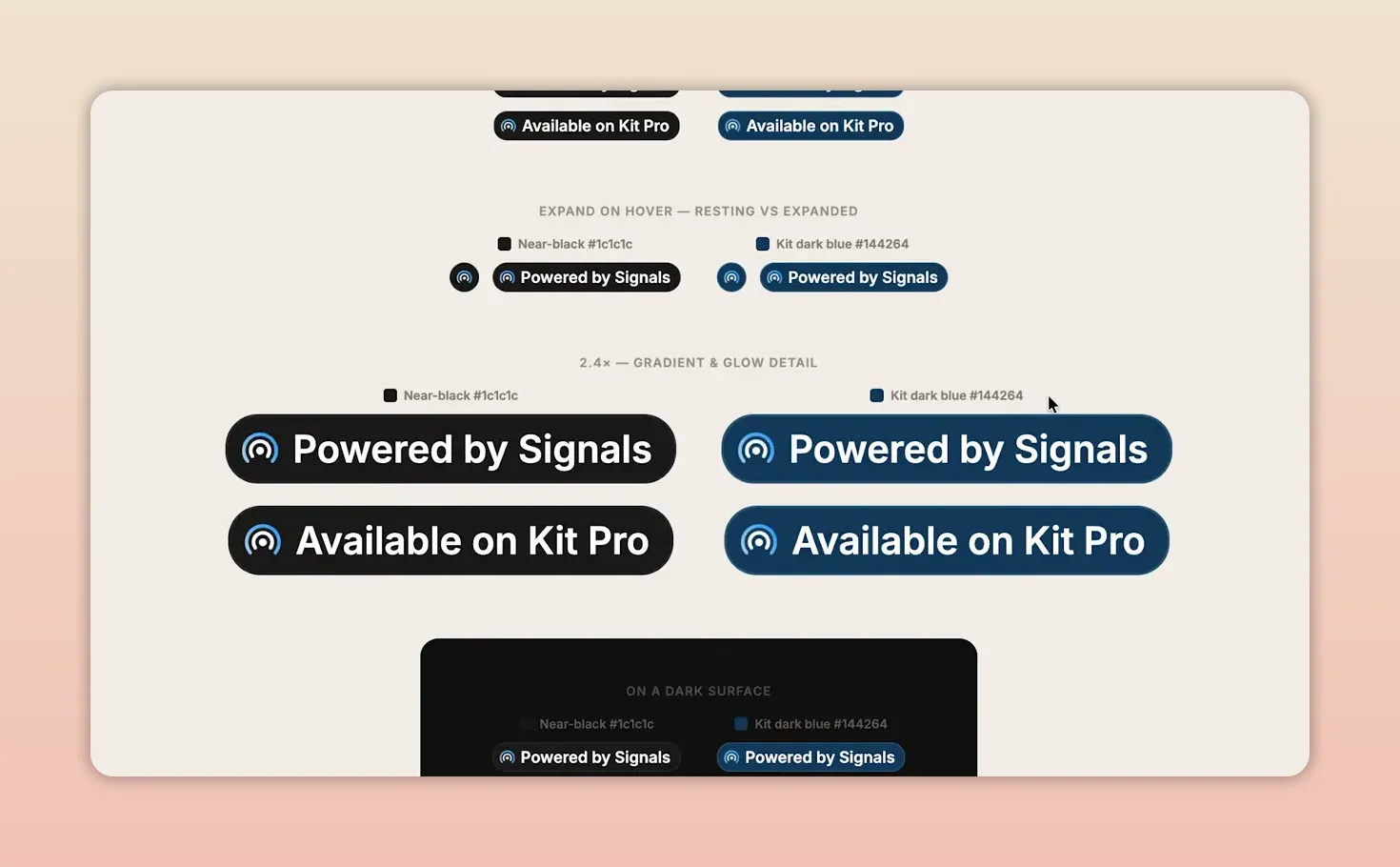
By the end of the discussions, we had several directions to take further:
- A badge in the navigation indicating that someone has a Pro account.
- A possible change to the navigation colour for Pro.
- Shared badge styling that could connect individual features back to the Pro experience.
- More breathing room in modals to help the experience feel premium.
- Dark backgrounds, gradients, grain, and texture as possible visual treatments.
Dark backgrounds with gradients were an obvious starting point. There is value in using visual language whose meaning is already familiar. Familiarity helps people recognise what something is communicating, rather than having to learn every cue from scratch, a principle explored in Nielsen Norman Group’s guidance on recognition rather than recall.
But we also wanted to move beyond the obvious. A grainier gradient treatment felt potentially more like Kit, and we still needed to explore ways of communicating premium value without relying on gradients at all.
The conversations went well. Most importantly, people aligned around the broader framing: we were developing an expression for Pro, not branding Subscriber Signals in isolation.
My final meeting was with Brand Studio to discuss process bottlenecks and ways to remove them. The asset generator was already one example of that thinking, reducing the need for a designer to handle every templated asset request.
Before leading another discussion, though, I needed to step away from the screen. Watering the plants seemed like a much better use of that short break than staring at another tab.
Thursday: People Management, Survey Results, and a Flexible Deadline
Thursday began with a HIIT class in the park, followed by an unusually early meeting at 11:15 with Saskia to work through next steps from the previous day’s design feedback.
By this point, I was thinking that I should measure how much of my time goes towards planned project work versus urgent decisions and requests for help. I had not expected Subscriber Signals to take up so much of the week.
Still, it was one of the business’s highest priorities. Shifting my attention towards it made sense. Prioritisation is not something I finish on Monday morning. It is a decision I keep making.
Making career feedback specific
One of my two core priorities was a people-management task. I owed a team member a clear assessment against our competency framework so we could discuss their development and a path towards promotion.
Our career framework has five levels and combines:
- Business impact: Company-wide expectations.
- Ownership and accountability: Also consistent across the company.
- Functional skills: Expectations specific to the role or team.
In Brand Studio, designers and our writer share a framework for creative production, applying those expectations through their own areas of expertise.
I wanted to work through it carefully enough to give genuinely clear feedback on where the team member was operating within each competency. That takes attention, and it deserved a proper place in the day rather than whatever energy was left over.
New information changes the plan
The other main priority was the company-wide repositioning update. I had planned to prepare it on Wednesday and record it Thursday morning. That had not happened.
I tried using Claude to help create a first draft of slides from a recent written update and the project overview. Other team members had been getting good results with it, and I hoped it would speed up the initial assembly.
After spending a few hours working from a coffee shop and meeting a friend for lunch, I came home to find that the brand awareness survey results were in sooner than expected.
That was exciting because it meant I could include real findings in the company update. It also meant I spent time digging into data I had not expected to have that day.
I put the data into a Claude project and asked it to create artifacts that would help me interact with it. I was also considering making the project available internally so other people could ask their own questions of the research.
Conveniently, an agency meeting moved to Friday, giving me some extra room. I needed it.
AI can produce more words than you need
By 7 p.m., the slides still were not ready. I had one more campaign meeting, plus agency work to review, so I asked whether I could publish the update on Friday instead.
The answer was yes.
A useful reminder to myself: I can ask whether a deadline is flexible.
This connected directly to the internal AI writing guidelines I had been working on. AI is very good at producing something long and wordy. It still takes real effort to distil information, make it concise, and decide exactly what people need to understand.
The difficult part of this update was not getting enough material onto slides. It was working out which ideas mattered most to the wider company. Giving myself more time meant I could make the communication more useful, not simply more polished.
Friday: Sewing First, Then Bringing the Week Together
After several late working nights, I did not want to treat being ready early on Friday as an automatic invitation to start work early.
My strength class was at 8:30, and by 10 a.m. I could have opened the work laptop. Instead, I started a sewing project.
Making something for myself
I wanted to make a boxy, cropped shirt using pink striped fabric I had bought at Mood in New York, with pale pink buttons to match. I had never made a collar before, so that would be a fun challenge.
There was a possible purpose for it too. I had booked a brand photoshoot for my own business at the end of the month. My existing photos showed older versions of me, including purple hair and blonde hair, and I wanted new images taken in my own office.
I was feeling the energy to return to my website and services, and wearing something I had made felt right for that next stage.
First, though, came the less glamorous part: assembling a printed PDF pattern. I also planned to make a test version using a €5 duvet from IKEA’s seconds pile. That lets me check the fit and understand the construction before cutting into the nice fabric.
Sewing is not faster or cheaper than buying clothes. That is not why I do it. It is rewarding to make something, learn something, and have a creative process that is mine.
So, even though the work list was long, sewing came first.
Giving the agency useful creative direction
When I opened Slack, I found that the discussion about the positioning book was being rescheduled. That freed up an hour and removed the immediate pressure to finish more of the exercises before the meeting.
My first priority became pulling together a mood board for the agency meeting. The company update also needed finishing, but the mood board had a fixed dependency: it had to exist before the agency call.
I set a focus timer for 30 minutes. It took longer. Of course it did. But the time was well spent.
The board brought together our recent internal brand exploration:
- Connected, floating UI elements that tell a story rather than relying on one static image.
- Texture and colour that could make dark backgrounds feel more distinctly Kit.
- Light-background treatments that could still feel premium.
- Nuanced exploration of background tones and the text colours placed over them.
- Bolder social graphics, overlapping elements, and subtle texture.
We were asking the agency to work in a slightly awkward situation. We had brand guidelines, but we were also actively evolving how we used our brand elements. Sharing the work and the thinking behind it was important because a static set of rules could not fully explain where we were heading.
The meeting went well, and we came away with clear next steps.
Finally sending the company update
I used the extra time on the update to bring in insights from the survey. My planned five-minute Loom turned into something closer to 12 minutes, but there was a lot to communicate.
I stood up to record it, which helps me get into a more confident presenting mode, and finally sent it out.
That felt good. And honestly, it had needed the time I spent on it. Distilling the project, the reasoning, and the research into a useful company-wide communication was substantial work in its own right.
Not everything got done. The preparation I wanted to finish for our new part-time contractor would have to happen on Monday morning before she started. Not ideal, but that was where things stood.
I had, however, worked through my saved Slack items. Some no longer needed feedback because the moment had passed and the work had moved on. That is part of the reality too: everybody needs something, and I cannot contribute to every conversation.
What a Productive Creative Director Week Actually Looked Like
By Friday afternoon, I felt fairly brain-dead, but good about the week. We had launched a survey and received results within the same week. We had made campaign decisions, developed thinking around our positioning and ideal customer, aligned around a more systemic approach to Pro design, and improved the asset generator.
There was people-management work in there, agency collaboration, process improvement, and a substantial internal update. A lot had happened, even if the task list had not become dramatically shorter.
I ended the week with a networking call with James from Showit. Every now and then, I like to speak with someone doing a similar role at another company. It is useful to get outside our own processes and hear how other teams operate.
It also had me thinking about bringing back Inside Marketing Design, where I have spoken with people working in and leading brand teams at tech companies about their projects and team structures. A possible new season could focus on how brand studio teams are using AI, partly because that is something I genuinely want to learn more about myself.
That combination probably describes the role quite well: making decisions, helping other people move forward, learning enough to ask better questions, and continually adjusting the plan.
The week did not go exactly as I intended. The important work still moved forward. I can feel good about that, even with a few things waiting for Monday.


