In October 2023, I realised I was burned out and needed a break from making videos. Until then, I’d been pretty consistent. Creating design content and running a business alongside my full-time job had been part of my life for more than a decade.
Ever since that break, I’ve been figuring out what balance actually looks like for me. Work, life, content creation, running a business: all of those things take effort. What I’m learning is that different seasons of my life leave me with different amounts of energy to give to each of them. And that’s okay.
Lately, some of that energy has started coming back. I feel a bit more like myself again. That doesn’t mean I’ve neatly solved burnout, but it does feel like a good time for an honest catch-up about work, the things bringing me joy, my very long-running book project, and how I’m thinking about AI as a designer.
Nearly 10 Years at Kit, and Still Growing
Work has been busy. In June, we had our biggest launch ever at Kit, and I’m incredibly proud of the team and everything that went into it, including the motion graphics work I’ve been experimenting with.
I’m also approaching a slightly wild milestone: 10 years at the company in December.
Staying somewhere for that long doesn’t necessarily mean doing the same thing for a decade. I’ve experienced lots of different eras of Kit, just as I’ve gone through different seasons in my own life.
Right now, we’re in a growth phase. That means growing our customer base and revenue, rather than necessarily growing headcount. We try to stay efficient as a team, and that makes this a demanding period.
What keeps me motivated is that we’re improving. Our brand feels stronger than ever, and the quality of the assets we’re producing keeps getting better. It’s a lot of work, but it’s work I’m proud of.
Balancing design leadership with a side business
The balance between my job and my own business has been harder.
For me, a senior leadership role in tech isn’t something I can neatly contain between opening and closing my laptop. Some people might be able to stop thinking about work at the end of the day. I’m not particularly good at that.
My job pays my bills. My content creation business has always been something I do on the side, so when I didn’t have enough energy for everything, I needed to pull back from the business to make sure I could give my best to my employed work.
That’s why so much content creation stopped. It wasn’t that I suddenly had nothing to say or no interest in making things anymore. I just didn’t have the capacity.
Now I’m starting to feel like I have energy for both again, which is exciting. I don’t want to get ahead of myself and make grand promises, but I am beginning to put more effort into my business because that effort feels available again.
Navigating Burnout by Making Room for Joy
The biggest thing helping me navigate burnout has been spending time on things that bring me joy.
That sounds simple. It was not, apparently, something I could learn the easy way.
I have a lot of respect for my past self and how much effort she put into everything. That effort helped get me to where I am now. I don’t want to dismiss it or pretend I regret all of it.
But I overdid it. I wish I’d understood earlier that doing something without a productive purpose can be valuable in its own right. For me, making space for fun has helped my wellbeing and given me more energy for the things that do need to be productive.
This is my own experience of navigating burnout, rather than a universal recovery plan. The World Health Organization’s explanation of burnout provides some useful context around the term.
Sewing things just because I want to
Yes, I’m still sewing. Very much so.
Recent makes include several dresses, a skirt, and linen shorts. One floral dress has both boning and tulle in it, which makes it my fanciest sewing project yet. I’ve also made a pink top that goes with the shorts, although that was an earlier project.
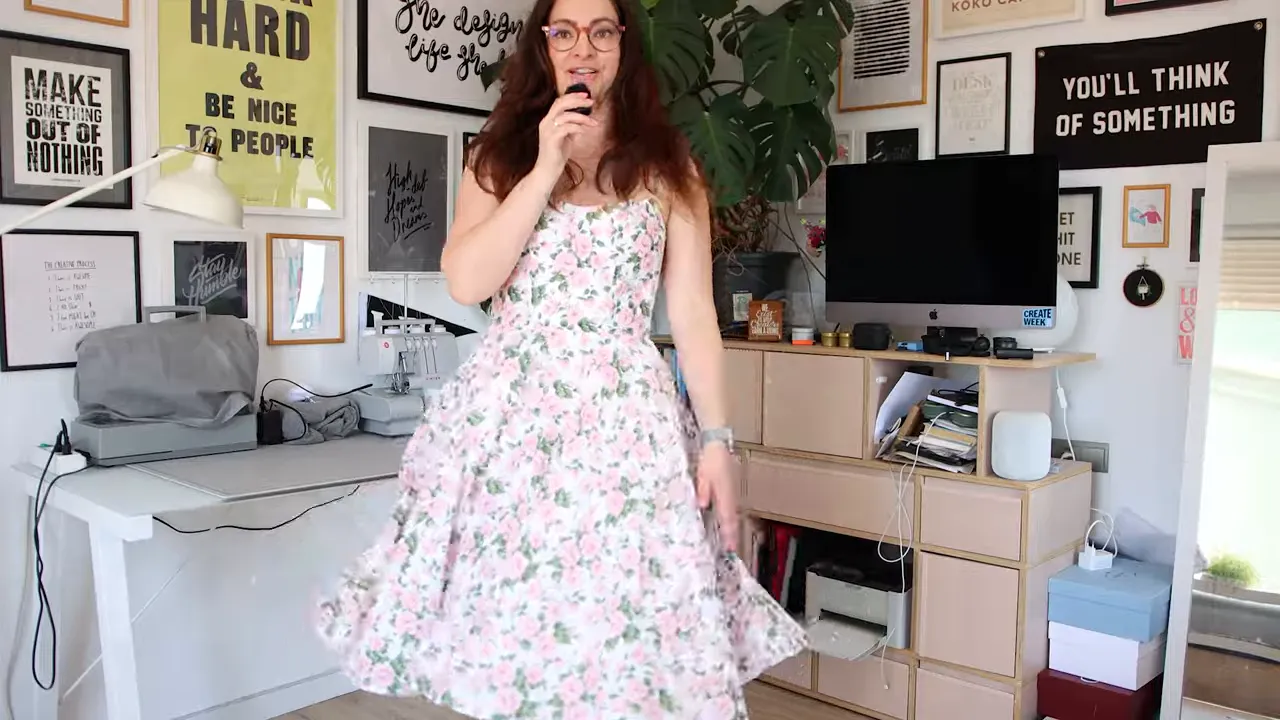
I started a separate sewing Instagram account, Charli Sews, as a little gallery of the things I’ve made. I haven’t been especially good at keeping it updated, but the sewing itself is happening. There’s also an entire cupboard of fabric waiting to become more clothes.
It brings me a lot of joy to spend time making something that isn’t connected to my design career.
Being a beginner at golf
I’ve also got into golf, which feels like a slightly random addition to my hobbies, but I’m having a great time.
My grandparents were keen golfers, and I’m sad it took me this long to discover it. It would have been lovely to share that interest with them.
I’m still very much a beginner. I’m not particularly good. But I enjoy doing it, and that is the important part. Not everything needs to become a demonstration of competence.
Finding community in Valencia
I moved to Valencia in 2019, but it’s only really in the past couple of years that I’ve felt I have a proper community here.
Building that took time. Now I have a wonderful group of friends, and prioritising time with them has made a big difference. Friendship isn’t a hobby, obviously, but it belongs in the same conversation about making room for things that make life feel good.
I still have good days and bad days. I’m not trying to present this as a perfectly resolved situation. Lately, though, there have been more good days than bad ones, and that matters.
Buying My First Car Has Helped Me Get Out More
One surprisingly great addition to my life has been becoming a car owner for the first time.
I’ve always lived in cities, so I never really needed a car. Honestly, I still don’t strictly need one. But I wanted to get out of the city more on weekends, visit my in-laws more often, and make it easier to get to the driving range.
I bought it about a year ago, a fact recently reinforced by my insurance renewal and annual maintenance appointment. It’s fully electric, and it has turned out to be one of the best purchases I’ve made.
I’m particularly proud that I bought it myself, entirely in Spanish. Could I have negotiated a better deal if my Spanish were better? Probably. But I did it, and I’m taking the win.
More importantly, it encourages me to leave the house. I’ve become the driver in my friend group, which has meant beach trips and a day trip to Altea in January. It also makes hikes and family visits easier.
The value hasn’t just been owning a car. It’s been all the things it’s made easier to go and do.
Movement, Morning Routines, and Time Away
Another thing helping with burnout has been building a movement routine that I genuinely enjoy.
I go to yoga classes in the park and at the beach, and HIIT classes in the park too. Group fitness used to be something I actively disliked. I wanted to be left alone to do my own thing, without exercising around other people.
Now I love it. Apparently, that can change.
The routine matters as much as the exercise. Starting the day by giving some time to myself, before giving it to work or a project, has been really helpful. It’s a way of making sure my own needs actually get some attention.
That yoga community also led to a retreat in Croatia with an amazing group of women. Croatia wasn’t especially on my travel list beforehand. Now I would happily go back immediately. Tomorrow would be fine.
I also travelled to New Zealand to spend time with family and attend my cousin’s wedding. Travel is another part of life I’m choosing to devote time to, rather than treating everything outside work as something to squeeze in around it.
The Marketing Design Book Is Still Happening
I recently discovered that I’ve been working on my book for eight years. I thought it was five. Eight was a bit of a shock.
To be fair, it started as a different book.
What it has become is a book about doing impactful marketing design work. It’s written for in-house designers, particularly those in tech companies, who want to grow in their careers and reach a greater level of strategic impact. I think the ideas are relevant in other kinds of companies too.
At its core is a framework for approaching design work and balancing the effort you put into a project with the impact it’s likely to have.
It brings together what I learned as an individual contributor in marketing design. I haven’t been in that role myself for a while now. I still manage designers doing that work, but my day-to-day responsibilities as a creative director are very different.
Finishing the book feels like a way to bring that phase of my career together and put what I learned into something useful.
A book is not 12 blog posts
One of the biggest lessons has been that writing a book is not simply writing a blog post 12 times.
A book with 12 chapters sounds manageable when you think of each chapter as a separate article. But the chapters have to work together. You’re building an overall narrative and a progression in what you’re teaching.
It feels closer to creating a curriculum in written form. The language, examples, and nuance all need to support the larger learning experience.
I haven’t always enjoyed the writing process. I have, however, enjoyed having a project of this size.
So much of content creation involves things you could technically finish in a day, even if they take the whole day. A book is not one of those things. You have to keep working on pieces of it without getting that immediate satisfaction of a finished project.
I’d love to call my progress steady, but that wouldn’t be honest. There has been progress, with plenty of ups and downs.
I’ve now sent the manuscript to the two designers on my team for feedback. Somehow, I’m more nervous about them reading it than I was about the strangers who beta read it in January. I’ll probably do another round of beta reading before calling it finished.
The finish line isn’t close yet, but I can see it in the distance. That feels good.
My Honest Thoughts on AI in Design
I understand the concerns about AI. Its environmental impact, what it might do to our attention spans, workloads, and ability to think critically: I share a lot of those worries.
At the same time, I’ve chosen to work in tech. From where I sit, AI has very quickly become a normal part of working in this industry, and increasingly an expectation.
Holding both of those thoughts at once is uncomfortable. But that’s honestly where I am.
What has surprised me most
The speed at which AI has become part of my process has been surprising.
I use it to help with writing work documents, not my book, and sometimes as an alternative starting point to search or as a thinking partner. Those uses already feel normal in a way I wouldn’t have expected so quickly.
It also keeps surprising me with tasks I assume it won’t handle well. Sometimes it produces something passable, and that can be both interesting and quite scary.
I got a noticeably negative response to my recent content about Claude and design. I suspect some of that was because AI is such a contentious topic. Or perhaps people just didn’t like what I made. I don’t know.
What I do believe is that fear and anxiety can’t be the only things guiding how we respond to it.
Designers still need to understand the tools
Previously, designers were expected to know Photoshop, Figma, Sketch, or whichever tools helped us bring ideas to life. I think understanding how to use AI is becoming another part of that toolkit, particularly for those of us working in tech.
That doesn’t make the tool the point of the job.
Our value is in solving problems, not simply operating software. This is also a big theme in my book: becoming a strategic partner and approaching work without making any one tool central to your identity.
AI is another possible way to solve a problem. We still need the judgement to decide how to use it and whether the result is good.
My approach is to help shape how the company uses it
People across tech companies are going to experiment with AI to meet their own design needs. My approach isn’t to fight every instance of that happening. It’s to become a useful resource for doing it well.
As a creative director, the questions I’m working through include:
- How can I set up design system guidance for tools like Claude?
- How can I help people recognise good design and critique what AI produces?
- How can I train the team to use these tools without lowering our quality standards?
- Where can AI genuinely help our existing processes?
We’ve spent years building a brand and establishing a quality bar. I don’t want that work diminished because something generated quickly looks convincing at first glance.
Helping colleagues make better decisions feels like a more useful response than pretending they won’t use these tools.
Learning AI is not a guarantee of job security
It’s incredibly sad and disappointing to see layoffs with AI cited as a reason. I think designers can demonstrate value through the better results we’re able to get from these tools, using our existing skills and judgement.
But I want to be very clear about something: I am not saying that any designer who has been laid off could have prevented it.
There are changes happening across tech that are far beyond any individual’s control. Learning a tool does not give you control over a company’s decisions, and it does not make you responsible for losing your job.
My point is about the limited things we can influence. Given the uncertainty in tech, I believe learning to use AI effectively is something we need to do if we want to keep working in this industry. That isn’t a promise of safety or an endorsement of every decision being made around it.
The expectation of instant, high-quality work worries me
One impact I’m already noticing is the expectation that design should now be faster and easier. More output, less time, very little patience.
AI can produce something that looks polished on the surface. Once you dig into it, though, it doesn’t always make as much sense as that first impression suggests.
That gap matters. Looking designed and being well designed aren’t necessarily the same thing.
I’m also reluctant to build an argument around declaring that AI will never be able to do a particular task. It’s improving quickly and keeps surprising me. Something it struggles with today might be something it handles differently tomorrow.
I don’t want women left out of the AI conversation
Something else has been on my mind: the difference in the gender breakdown between two recent pieces of content.
My career goals video had a fairly even split between men and women, which is quite normal for my audience. The one about Claude and design skewed much more heavily towards men.
That comparison isn’t proof of an industry-wide trend. But it does make me worry about women being left out of, or put off by, the AI conversation.
There’s a lot of very “tech bro” energy around AI and design. I worry that it makes the space feel unappealing, and I don’t want female designers to face another barrier to career growth.
Exploring AI is a large part of my job right now. It’s my responsibility to understand the landscape, figure out how I expect my team to use these tools, and find where they can support our work.
That means AI and design will be a bigger part of what I share as I return to creating more regularly. Not the only part, but an honest reflection of what I’m working on and learning.
What I’d Tell My 20-Year-Old Designer Self
I don’t regret being ambitious in my twenties. I put a lot of time into creating content, building a business, learning, growing, and pushing myself. Those things mattered to me, and they brought opportunities.
What I wish is that I’d applied some of that same focus and enthusiasm to life outside work.
I’ve ended up tying too much of my self-worth to what I do professionally. That isn’t healthy, and I’m working on separating the two now.
So my advice wouldn’t be to stop caring about your career. It would be to keep following your interests, stay enthusiastic and optimistic, and try things. Don’t rule yourself out of opportunities because you think you’re too young, or let someone else convince you that you shouldn’t go for them.
But do other things too.
Pursue hobbies. Be a beginner. Make things purely because they’re fun. Give your friendships and interests some of the energy you give to becoming a better designer.
Growing as a person is just as important as growing in your career.
That’s what I’m trying to make room for now. There have been real struggles behind the long gaps in my creative work, including plenty of things I filmed and never found the energy to finish. I don’t need to keep dwelling on all of that to acknowledge it happened.
I’m glad to be feeling more like myself. I’m glad there’s more joy in my life. And I’m excited to create again, while continuing to make space for everything else.


